


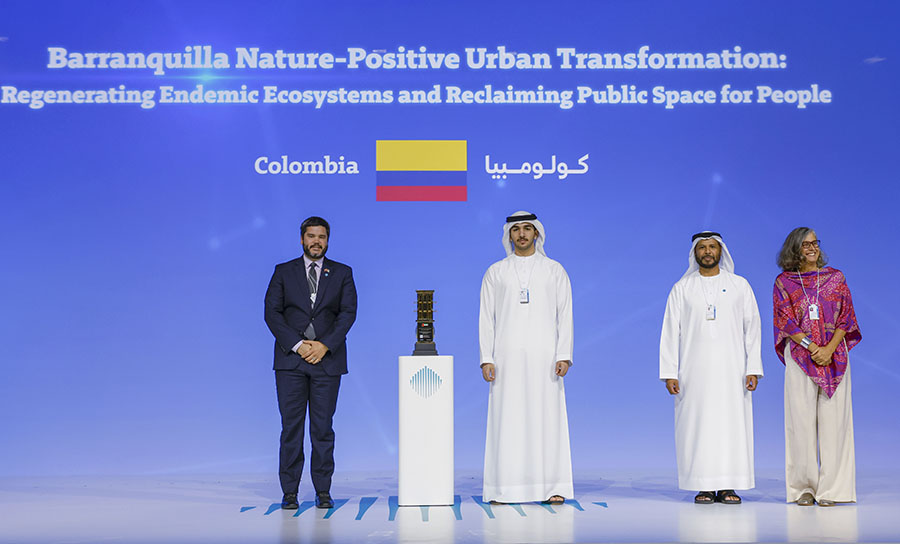
Under the patronage of His Highness Sheikh Mohammed bin Rashid Al Maktoum, Vice President and Prime Minister of the UAE and Ruler of Dubai, and as part of the World Governments Summit (WGS) 2026, His Highness Sheikh Mohammed bin Rashid bin Mohammed bin Rashid Al Maktoum honoured the winners of the 14th edition of the Dubai International Best Practices Award for Sustainable Development.
Organised by Dubai Municipality in collaboration with the United Nations Human Settlements Programme (UN-Habitat), the Award recognises outstanding global projects, ideas, and innovative practices that advance sustainable urban development, improve quality of life, and enhance living environments worldwide.
His Highness Sheikh Mohammed bin Rashid bin Mohammed bin Rashid Al Maktoum affirmed that, for over three decades since its launch, the Award has played a pivotal role in positioning the UAE and Dubai as a nurturing environment for creative talent and a global reference point for shaping the standards of future cities. The Award promotes human-centric urban planning approaches that prioritise wellbeing, sustainability, and resilience as core principles of urban development.
His Highness said: “Our goal is for the Award to serve as an inspiring global reference that motivates individuals and institutions around the world to develop innovative solutions, projects, and urban practices that support sustainable growth and enhance quality of life. We believe that building a better future for communities and future generations begins with believing in the importance of change today and thinking proactively about creating cities that are more resilient, sustainable, and liveable.”
Pioneering projects
This year’s Award recognised four winning projects across its different categories, reflecting diverse geographies, challenges, and innovative approaches to sustainable urban development.
Best Practices Award in Urban Regeneration and Public Spaces
The Best Practices Award in Urban Regeneration and Public Spaces was granted to the Mallorquín Swamp Renewal Project – Nature-Positive Urban Transformation in Barranquilla: Revitalising Local Ecosystems and Restoring Public Spaces for Residents, from the Republic of Colombia. The project rehabilitates more than 740 hectares of wetlands and urban green spaces through mangrove reforestation and phytoremediation, involving 250,000 trees – most of which aremangroves – in addition to the creation of more than 200,000 square metres of public spaces.
Best Practices Award in Sustaining Urban Food Systems
The Best Practices Award in Sustaining Urban Food Systems went to Cascais Harvest Haven – The Urban Agriculture Strategy of Terras de Cascais, from the Portuguese Republic. The strategy transformed 17.6 hectares of urban and peri-urban land into a sustainable and integrated food ecosystem, incorporating 34 community gardens, five orchards, and 67 school gardens and training farms. The initiative supports more than 5,000 beneficiaries, particularly low-income families, and produces approximately 40 tonnes of organic food annually.
Best Practices Award in Urban Infrastructure Planning and Management
The Best Practices Award in Urban Infrastructure Planning and Management was given to the Decent Life (Haya Karima) initiative from the Arab Republic of Egypt. The national initiative aims to improve the quality of life in rural Egypt and serve more than 60 million citizens as part of Egypt Vision 2030. It includes comprehensive infrastructure development covering water, electricity, and sanitation networks, as well as the upgrading of roads, schools, and healthcare centres in more than 4,500 villages across 20 governorates. The programme is being implemented in three phases, addressing varying poverty levels. The first phase covered 1,477 villages, while the subsequent two phases target the execution of more than 27,000 service and development projects.
Best Practices Award in Addressing Climate Change and Reducing Pollution
The Best Practices Award in Addressing Climate Change and Reducing Pollution was awarded to Blue Circle Marine Waste Management from the People’s Republic of China. The project is a smart system for managing marine waste and ship-generated pollution, leveraging data, blockchain, and artificial intelligence across 14 coastal cities. It operates through a collaboration network involving more than 13,000 vessels, enabling the collection of 19,600 tonnes of marine waste by 2025 while strengthening marine plastic recycling pathways to produce low-carbon industrial materials.
Fostering global cooperation
His Excellency Marwan Ahmed bin Ghalita, Director General of Dubai Municipality, said: “The Award reinforces Dubai’s position as a leading global hub for designing inclusive, resilient, and sustainable future cities that place human wellbeing and quality of life at their core. It also reflects the UAE and Dubai’s commitment to strengthening international cooperation and advancing sustainable urban development pathways that protect the environment and enhance urban living.”
He added: “The Dubai International Best Practices Award celebrates exceptional ideas and projects that achieve balance across environmental, social, urban, and technological systems. It provides a valuable global platform for sharing knowledge, drawing inspiration, and scaling innovations that contribute to resilient infrastructure and improved quality of life for communities worldwide.”
Record participation
The 14th edition of the Award attracted more than 3,000 submissions from 152 countries, marking the highest participation in its history. This record engagement underscores the Award’s global appeal and its reputation as a leading international benchmark for recognising impactful urban practices that advance human wellbeing and sustainable development.
The Award reflects the UAE and Dubai’s commitment to fostering international collaboration, building bridges between governments and institutions, and supporting innovative ideas that contribute to more sustainable, inclusive, and liveable cities.
Key contributor
Dubai Municipality is participating as the Smart City Partner in the WGS, now in its 13th edition, held under the theme ‘Shaping Future Governments.’ The Summit brings together 150 government delegations, more than 80 international and regional organisations, and global institutions, alongside a distinguished group of thought leaders and experts, with the participation of more than 6,000 attendees.