


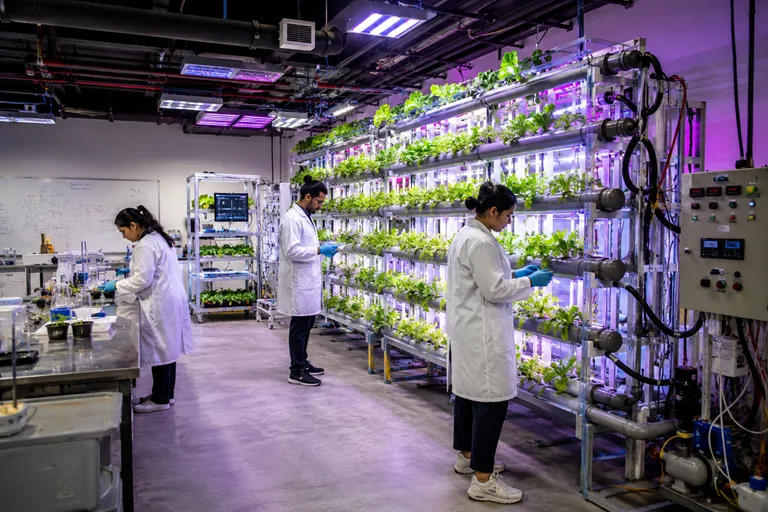
As the global drive for practical solutions to challenges related to water, food, energy and resources accelerates, innovation ecosystems are playing an increasingly important role in translating research and development into real-world applications and connecting emerging technologies with the needs of industry and markets.
Sharjah stands at the forefront of this drive, led by the Sharjah Research, Technology and Innovation Park (SRTI Park), which has created an ecosystem that brings together research and development, technology, entrepreneurship, investment and industry, creating pathways for solutions to be developed, tested and transformed into scalable projects.
This approach positions sustainability not only as an environmental imperative, but also as an opportunity for innovation, business development and investment, particularly in sectors where environmental challenges are driving demand for more efficient technologies.
From Innovation to Real-World Application
Sharjah’s innovation ecosystem is home to a growing range of technologies being developed and tested across mobility, infrastructure, advanced manufacturing, construction and digital technologies.
Among these is uSky Transport’s suspended transport system, which offers a new approach to future mobility and infrastructure. The ecosystem also encompasses innovative projects in conductive concrete and green hydrogen.
Another example is Maxbyte, which is deploying artificial intelligence, robotics and digital technologies to support industrial transformation, improve productivity and advance more sustainable manufacturing practices.
The ecosystem also includes projects in digital infrastructure and data centres, as well as advanced construction technologies, including a 3D-printed house, demonstrating the potential of additive manufacturing in the built environment.
Alongside these projects, innovation in food security and agriculture, water management, clean energy, the circular economy and environmental technologies is generating opportunities for technology companies, investors and emerging ventures.
These include precision agriculture and AI-enabled farming, smart water management and reuse, emissions-reduction technologies, renewable energy, hydrogen, energy storage and circular economy solutions that recover and transform resources into new value.
Lab to Market
Moving from the laboratory to the market remains one of the key challenges facing emerging technologies. Innovations need environments where they can be tested, partners capable of deploying them, and investors able to support their growth.
An integrated ecosystem bringing together researchers, innovators, startups, industry, investors and government entities can create clearer pathways for collaboration, technology transfer and pilot projects.
For startups, such an environment provides access to potential partners and customers while enabling them to validate their technologies. Industry gains opportunities to test new solutions against real operational challenges, while investors gain greater visibility into technologies and companies with growth potential.
In this model, technology can move beyond a prototype or research outcome to become a solution tested in real-world conditions, refined through practical application and prepared for wider markets.
Water, Food and Energy
Water, food and energy are among the sectors where sustainability, innovation and economic opportunity increasingly intersect.
In agriculture and food security, artificial intelligence, sensing, automation and data-driven technologies are enabling more efficient use of resources and improved productivity.
In water, advanced treatment, desalination, smart management, reuse and resource recovery technologies are creating opportunities for more sustainable solutions while strengthening the connection between research and the needs of utilities and industry.
In energy, opportunities are expanding across renewable energy, storage, hydrogen, energy management and smart infrastructure, supporting the transition towards more efficient systems.
The circular economy represents another area where technology and commercial opportunity converge. Solutions that reduce waste, extend the use of resources, support recycling and recover value from waste streams can improve efficiency and reduce costs while creating new business models.
Where Challenges Meet Solutions
The strength of an innovation ecosystem lies in connecting different players across the innovation value chain. An industrial company may have a challenge requiring a technological solution, while a researcher or startup may have the technology to address it. Both need an environment where the solution can be tested, refined and demonstrated.
At the same time, investors are seeking technologies with genuine growth potential, while startups need customers, partners, funding and access to markets.
This creates a bridge between knowledge, technology, industry and capital, transforming collaboration into practical projects, products and commercial opportunities.
Sharjah Next – Sustainability: A Vital Platform
Against this backdrop, Sharjah Next – Sustainability, set to take place on October 28 and 29, 2026, at SPARK, is positioned as a strategic platform to accelerate sustainability innovation. The two-day forum will bring together researchers, businesses, government entities, investors and technology providers to advance the localization, commercialization, piloting and deployment of scalable sustainability solutions.
The programme focuses on food security and agriculture, water, environmental solutions and the circular economy, clean energy and energy efficiency, sustainable innovation financing and emerging technologies.
Beyond dialogue and knowledge exchange, the platform aims to connect companies, researchers, government entities and investors and explore opportunities for technology transfer, pilot projects, collaboration and investment.
Events such as Sharjah Next form part of a wider drive to strengthen Sharjah’s position as an attractive environment for technology companies, innovators, researchers and investors, supported by access to knowledge, talent, universities, industry, government and markets.
For startups, the ecosystem provides a pathway from technology development and validation to customers and investors. Industry gains access to technologies capable of addressing efficiency and sustainability challenges, while investors can identify companies operating in sectors with strong growth potential. Researchers, meanwhile, gain new pathways to translate research outcomes into applications with economic and societal impact.
Ultimately, the success of sustainability innovation is measured not simply by the number of ideas or technologies developed, but by their ability to move beyond the laboratory, demonstrate their value in real-world environments, enter the market and scale to deliver measurable impact.
Through these initiatives, Sharjah is strengthening an ecosystem connecting research, technology, entrepreneurship, investment and industry, creating opportunities for a new generation of solutions that can contribute to a more efficient, sustainable and future-ready economy.