


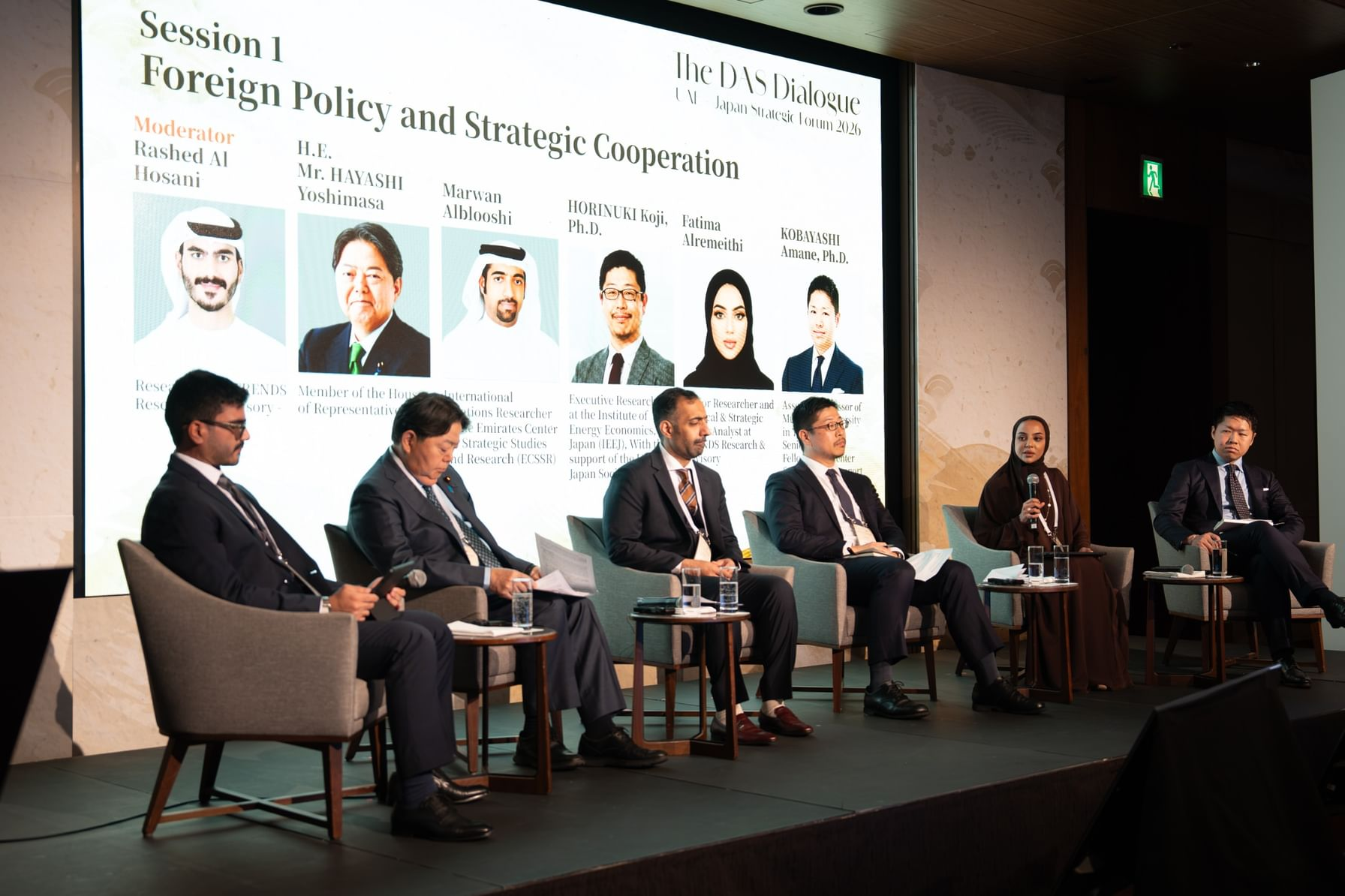
UAE and Japanese officials and researchers have called for advancing the strategic partnership between the two countries beyond traditional energy cooperation to encompass investment, advanced manufacturing, artificial intelligence (AI), water security and diplomatic coordination. They emphasised the importance of launching joint industrial partnerships, developing innovative water initiatives and strengthening research and economic cooperation to translate historic relations into practical and sustainable projects and initiatives.
The call came during the DAS Dialogue: UAE–Japan Strategic Forum, organised by TRENDS Global, part of TRENDS Group, in Tokyo under the theme From a Historic Energy Partnership to a Shared Future. The forum brought together senior officials, policymakers, experts, researchers, and representatives of think tanks and economic institutions from both countries.
The dialogue drew its name and historical significance from Das Island, the departure point of the first shipment of Abu Dhabi crude oil to Japan in 1962, symbolising more than six decades of cooperation and friendship and opening the way for a new chapter of comprehensive strategic partnership and economic and technological integration.
Dr. Mohammed Abdullah Al Ali, Chairman of the Board of Directors of TRENDS Group, said in a recorded address that the name DAS carries significant historical meaning, recalling the first Abu Dhabi crude oil shipment to Japan in 1962.
He noted that UAE-Japan relations, after more than six decades, are entering a new phase beyond traditional energy cooperation towards comprehensive strategic cooperation.
He highlighted the role of mutual trust and long-term vision in developing bilateral relations and their ability to adapt to international changes. He noted that energy, food and water security challenges make the Comprehensive Economic Partnership Agreement an important opportunity to expand trade and investment, strengthen private-sector cooperation, open new markets and develop cooperation in advanced manufacturing, AI, the digital economy and clean energy.
The opening session also featured remarks by Tsujii Akihiro, Assistant Vice-Minister and Deputy Director-General of the Middle Eastern and African Affairs Bureau at Japan’s Ministry of Foreign Affairs, who praised the continued development of bilateral relations.
The first session, Foreign Policy and Strategic Cooperation: The UAE and Japan in a Changing International Order, examined the development of bilateral relations in light of the Comprehensive Strategic Partnership Initiative and its implementation framework signed in 2022, as well as the conclusion of negotiations on the Comprehensive Economic Partnership Agreement in March 2026 and the importance of building on these frameworks to expand political, security and strategic coordination.
Yoshimasa Hayashi, former Japanese Foreign Minister and Member of the House of Representatives, moderated and participated in the session, alongside Fatima Al Rumaithi, Principal Researcher at TRENDS Research & Advisory; Dr. Koji Horinouchi, Director of Research at the JIME Center of the Institute of Energy Economics, Japan; Dr. Marwan Al Blooshi, Senior Researcher at the Emirates Center for Strategic Studies and Research; and Dr. Amani Kobayashi, Associate Professor at Musashino University and Senior Fellow at the Sasakawa Peace Foundation’s Mediation Support Center.
The second session, Trade, Investment and the Next Phase of Economic Partnership, explored opportunities arising from the UAE-Japan Comprehensive Economic Partnership Agreement and ways to translate them into tangible investment, commercial and industrial partnerships.
Moderated by Taro Han, Vice President of Asia Group, the session featured Sogano Masafumi, Director of the Middle East and Africa Division at Japan’s Ministry of Economy, Trade and Industry; Mouza Al Marzouqi, Principal Researcher and Director of the Economic Studies Department at TRENDS; and Rawya Al Blooshi, Researcher at the Emirates Center for Strategic Studies and Research.
The session highlighted opportunities in AI, advanced manufacturing, critical minerals, clean energy and digital infrastructure through the integration of Japan’s technological and industrial expertise with the UAE’s investment capabilities and global logistics networks.
Participants also called for expanding cooperation into third-country markets, particularly in Asia and Africa, through joint projects combining Japanese industrial and technological expertise with Emirati investment and logistics capabilities.
A key proposal was to launch a joint industrial partnership within the next 12 months, focusing on critical supply chains through the establishment of a UAE-based industrial project to manufacture strategic components, providing a practical model for translating bilateral understandings into tangible investments and projects.
The third session, Water Security and Resilience in the Face of Global Challenges, explored UAE-Japan cooperation in water-resource management and sustainable solutions ahead of Abu Dhabi’s hosting of the 2026 United Nations Water Conference.
Moderated by Professor Kenzo Hiroki of the National Graduate Institute for Policy Studies, the session featured Professor Kei Yoshimura of the University of Tokyo and Najla Al Midfa, a researcher at TRENDS Research & Advisory.
Speakers proposed launching a joint UAE-Japan initiative on climate-resilient water, to be announced in Abu Dhabi, developing scientific cooperation in early-warning systems and cleaner desalination technologies, leveraging the Comprehensive Economic Partnership Agreement to support water technologies and joint projects, and expanding related initiatives across Asia and Africa.
They emphasised that while energy laid the foundations for the first 60 years of the UAE-Japan partnership, water could shape the next 60 years.
The DAS Dialogue 2026 concluded by emphasising the importance of building on the discussions and insights from the three sessions and translating them into actionable programmes and initiatives to advance the UAE-Japan partnership across political, economic, research and technological fields.
Key recommendations included preparing a joint summary of policy and research priorities, establishing sustainable institutional links between think tanks in both countries, and identifying joint research projects to strengthen the exchange of expertise and knowledge.
The recommendations also included developing practical proposals to implement the Comprehensive Economic Partnership Agreement and encourage private-sector participation, identifying joint industrial and investment opportunities, and developing UAE-Japan water initiatives in support of the 2026 United Nations Water Conference.
They also highlighted the importance of exploring the possibility of holding the DAS Dialogue regularly, alternating between the UAE and Japan, to maintain engagement among decision-makers, researchers, experts and business institutions and provide a sustainable platform for following up on joint initiatives.