


UAE-based fuel technology company Fuelre4m has announced compelling new results showing that its fuel treatment can deliver real, repeatable fuel efficiency and emissions reductions across buses, trucks, and heavy equipment operating in demanding real-world conditions.
Independent testing led by the National Technical University of Athens (NTUA) one of Europe’s leading engineering and applied sciences universities, evaluated Fuelre4m’s technology under tightly controlled laboratory conditions using a commercial diesel engine operating on standard B10 biodiesel. The testing recorded 3.5–6.7% lower fuel consumption at identical engine speed and mechanical torque, alongside consistent efficiency improvements of 15–21% in the dominant mid-load operating range (approximately 1,400–1,550 RPM).
The laboratory result establishes a conservative baseline under fixed torque, while real-world operation allows the same efficiency improvement to reduce torque demand, improve gear behaviour, and compound over time, resulting in larger total fuel savings across a complete duty cycle. Crucially, the only variable introduced during testing was the treatment of the fuel itself, with no changes to engine hardware, electronic calibration, operating limits, or fuel specification.
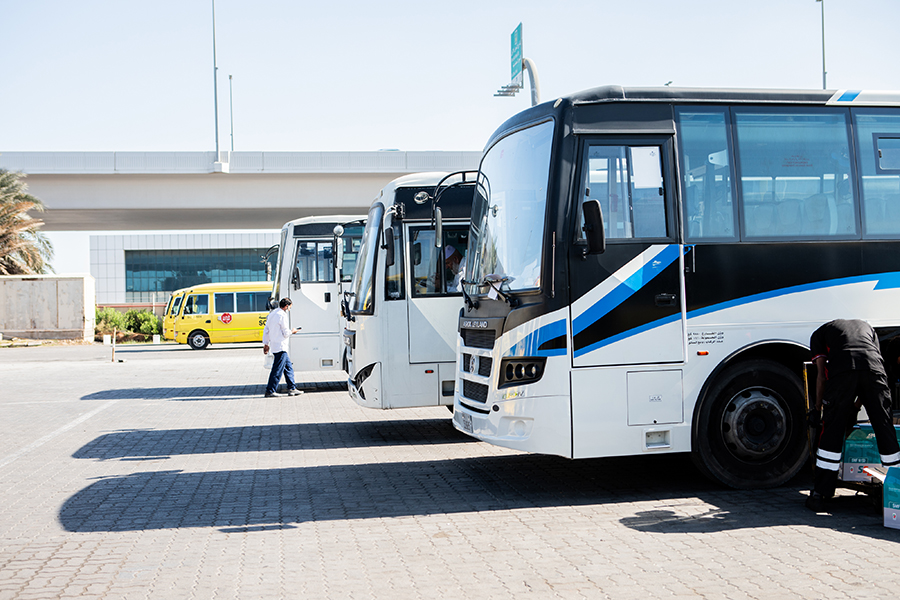
The NTUA laboratory findings are now being reinforced by repeatable real-world trials across UAE transport and industrial fleets. These include city and intercity buses operating on Dubai service corridors, mixed fleets incorporating VDL and King Long buses, and heavy trucks and off-highway equipment operating under high-load conditions. Across these trials, once sufficient fuel contact time is achieved, measured fuel efficiency improvements in service frequently match or exceed laboratory results, reflecting how gains express most strongly under real operating conditions.
Fixed-route trials on UAE buses show directional fuel consumption reductions of approximately 14%–17%, with the strongest improvements consistently appearing in the mid-RPM “working bands” that dominate urban and intercity duty cycles.
These trials were conducted across mixed fleets spanning multiple manufacturers, engine sizes, and emission standards, confirming that the benefits are not limited to a single platform or technology generation. No adverse impacts were observed on drivability, engine temperatures, or aftertreatment systems.
Fuelre4m’s performance extends beyond on-road transport. Quarry and heavy-equipment trials, including large off-highway haul trucks, demonstrated reduced fuel consumed per unit of work across multiple assets, with several recording double-digit efficiency improvements while maintaining or increasing productivity.
Commenting on the findings, George Papalambrou, Associate Professor of Control Systems at the National Technical University of Athens (NTUA), who oversaw the independent testing, said. “We were genuinely surprised by the consistency and magnitude of the mid-range efficiency improvements. The results were not isolated to a single operating point and were observed under multiple control regimes. This is a positive development not just for one sector, but potentially for all industries relying on internal combustion engines, including shipping and maritime transport.”
Unlike solutions that require new vehicles, alternative fuels, or infrastructure upgrades, Fuelre4m’s technology delivers immediate fuel and emissions reductions using existing assets. For fleet operators, even modest percentage improvements translate into meaningful cost savings and proportional CO₂ reductions, particularly in high-utilisation environments such as public transport, logistics, construction, ports, and terminals. By reducing fuel consumption without operational disruption, Fuelre4m’s technology directly supports the UAE’s Net Zero 2050 Strategy, enabling near-term emissions reductions while maintaining fleet availability and service reliability.
Rob Mortimer, CEO of Fuelre4m, said. “For decades, the industry has optimised engines around the assumption that fuel behaviour is fixed. These results show that when you improve how fuel behaves, efficiency and emissions improve immediately, using the engines already operating across the UAE today.”
Fuelre4m is now expanding controlled in-service validation programmes across the UAE in collaboration with fleet operators, government entities, and industrial partners. These programmes will focus on high-utilisation routes and duty cycles, long-duration performance validation, and quantified emissions reduction under representative operating conditions. Further independent testing using fully instrumented dynamometer facilities is also planned to extend validation into transient operation and regulatory-grade certification environments.