


Emirates Environmental Group (EEG) in association with Dubai Supreme Council of Energy and the Advancing Net Zero Volunteering Team successfully convened a panel discussion under the theme “Green Infrastructure and Retrofitting: Upgrading the Built Environment for Net Zero,”. This is the 4th panel that EEG is organising this year and it brought together a diverse group of stakeholders including policymakers, sustainability experts, urban planners, architects, engineers, researchers, industry leaders, educators and students to explore how the transformation of existing buildings and urban infrastructure can accelerate the transition towards a low-carbon and climate-resilient future.
The event provided an important platform for dialogue on advancing sustainable urban development through green infrastructure, energy-efficient retrofitting, nature-based solutions, circular construction practices and innovative technologies. Discussions focused on the urgent need to restructure the built environment to reduce greenhouse gas emissions, enhance resource efficiency and strengthen resilience to climate-related risks, while supporting national Net Zero ambitions and the global Sustainable Development Goals.
In her opening address, Dr. Habiba Al Mar’ashi, Co-Founder and Chairperson of EEG, underscored the urgent need to transform the built environment as a cornerstone of global climate action and sustainable urban development. She noted that the buildings and construction sector remain one of the largest contributors to global energy-related carbon emissions, making the retrofitting of existing infrastructure and the integration of green infrastructure indispensable to achieving Net Zero ambitions. Quoting estimates from the World Green Building Council, she highlighted that nearly 80% of the buildings that will exist in 2050 have already been constructed, emphasising that retrofitting is no longer an option but an urgent necessity for reducing emissions, improving energy efficiency and enhancing long-term resilience.
She further stressed that green infrastructure offers significant environmental, social and economic benefits by improving biodiversity, mitigating urban heat island effects, strengthening climate adaptation and much more.
She also highlighted the transformative role of emerging technologies such as artificial intelligence and smart building systems in optimising resource efficiency and operational performance, while emphasising that lasting progress will depend on enabling policy frameworks, innovative financing mechanisms, cross-sector collaboration and behavioural change. Dr. Habiba Al Mar’ashi also shared that while new sustainable developments continue to emerge, the greatest challenge and opportunity lie in upgrading existing buildings, infrastructure and public spaces through energy-efficient retrofits, sustainable materials, smart technologies and nature-based design. She stressed that achieving Net Zero requires strong collaboration among governments, industry, financial institutions, academia and civil society to create enabling policy environments, mobilise investment and accelerate innovation.
She also acknowledged the significant role of the EEG’s sister organisation, the Emirates Green Building Council in shouldering the UAE’s sustainability and Net Zero ambitions by promoting sustainable construction practices, fostering industry collaboration, facilitating knowledge exchange and strengthening capacity building across the built environment sector. She concluded her words by encouraging governments, businesses, institutions and communities to embrace sustainable construction practices, invest in green infrastructure and prioritise retrofitting initiatives as integral components of national climate strategies.
In his keynote address, Eng. Faisal Ali Al Rashid, Senior Director – Demand Side Management (DSM), Dubai Supreme Council of Energy, highlighted the growing importance of retrofitting as a key pathway for improving the performance of the UAE’s existing building stock. He emphasised the value of strengthening retrofit efforts across the country to enhance energy performance, optimise resource use and extend the efficiency and functionality of existing buildings, while noting the importance of coordinated action and effective implementation to scale up retrofitting initiatives and support the UAE’s broader sustainability and energy transition goals.
Reinforcing the importance of collaboraƟon in advancing the sustainability agenda, Leo Wu, ExecuƟve Director of Vantage FoundaƟon, Strategic Contributor to the event, stated:
“At Vantage FoundaƟon, we believe lasƟng progress is defined by the value we create for people, communiƟes, and the planet. Environmental responsibility is not a standalone iniƟaƟve—it is a long-term commitment that we are translaƟng into pracƟcal acƟon through trusted partnerships. We are proud to work alongside Emirates Environmental Group, aligned with the objecƟves of the UAE’s Net Zero 2050 Strategy, while contribuƟng to the United NaƟons Sustainable Development Goals. A sustainable future cannot be delivered by one insƟtuƟon alone. It requires shared leadership across business, government, and civil society. We are commiƩed to playing our part to connect global ambiƟons with local acƟon and help create impact that lasts.”
The programme commenced with an interschool debate, encouraging young people to criƟcally examine contemporary sustainability challenges and propose sustainable soluƟons to address them. The interschool debate, “Is Retrofiƫng ExisƟng Buildings a More EffecƟve Climate Strategy or Building New Green Buildings?”, brought together students from The Westminster School, Dubai represenƟng proposiƟon and GEMS Modern Academy, Dubai, represenƟng opposiƟon with The Westminster School, Dubai emerging as the winner
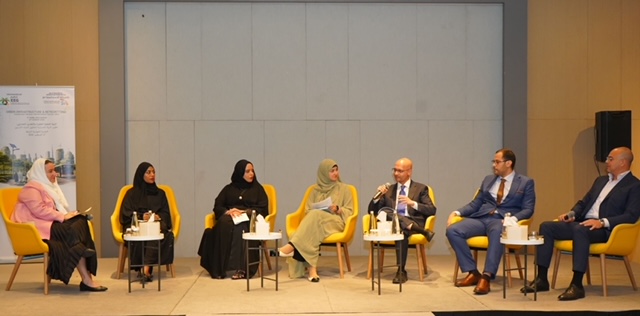
The panel discussion brought together key stakeholders from prominent naƟonal and internaƟonal insƟtuƟons including Dr. Eng. Aishah Hassan Al Shehhi, Engineering Expert, Ministry of Energy and Infrastructure, Dr. Fuad Baba, Assistant Professor, Department of Sustainable Design of the Built Environment, BriƟsh University in Dubai, Mr. Haithem Ibraheem, Vice President of OperaƟons, BGRE, Ms. Naveen Raza, Head of Net Zero TransiƟon | MENAT Sustainability, HSBC, Eng. Meera Alameri, Senior Specialist in Building Studies, Dubai Municipality, Mr. KarƟk Shankar Narayan, Chief Sales Officer, Berkeley Services UAE, L.L.C and Ms. Farah YassineChartered Environmentalist (Head of the Session).
Panellists highlighted that green infrastructure including urban forests, green roofs, permeable pavements, rainwater harvesting systems and integrated landscape design plays a critical role in improving urban resilience, mitigating heat island effects, enhancing biodiversity and climate adaptation.
Experts also discussed the importance of retrofitting existing buildings through energy-efficient systems, smart building technologies, renewable energy integration, improved insulation, efficient lighting and HVAC upgrades to significantly reduce operational carbon emissions.
The discussion further examined the role of digital innovation in transforming the built environment, including Building Information Modelling (BIM), artificial intelligence, Internet of Things (IoT) technologies, digital twins and predictive maintenance systems that optimise energy performance and building operations throughout their lifecycle.
The panel also put forward the importance of supportive policy frameworks, green financing mechanisms, sustainable procurement, regulatory incentives and public–private partnerships in accelerating large-scale retrofitting initiatives. Particular emphasis was placed on aligning urban development with circular economy principles by promoting resource efficiency, material reuse, waste reduction and lifecycle thinking across construction and infrastructure systems. The panellists underscored that creating Net Zero cities require designing healthier, more inclusive and resilient urban environments that enhance quality of life, strengthen economic competitiveness and ensure long-term environmental sustainability for future generations.
An engaging Q&A session followed, providing participants with the opportunity to directly engage with the panel of experts on topics including financing mechanisms for retrofitting projects, regulatory frameworks, implementation challenges, emerging technologies, stakeholder collaboration and strategies for accelerating sustainable transformation across the built environment.
This impacƞul session was made possible through the valued support of the Main Contributor, McDonald’s UAE, whose conƟnued commitment to EEG’s programmes and iniƟaƟves plays a vital role in strengthening plaƞorms for climate dialogue and also the engagement of Vantage Foundation, the Strategic Contributor, driven by its vision of empowering others to beƩer their futures. The event was hosted by Holiday Inn & Suites Dubai Science Park, which provided an excellent venue, ensuring a professional seƫng and seamless hospitality for all parƟcipants.
EEG organised the panel discussion in collaboration with the Dubai Supreme Council of Energy and the Advancing Net Zero Volunteering Team, under the Memorandum of Understanding signed last year to strengthen cooperation in advancing net zero commitments and sustainability action. The panel was further strengthened through the continued partnership of EEG’s collaborators, including the Emirates Green Building Council, the Clean Energy Business Council, the Swiss Business Council, Capital Club Dubai, and in association with the Arabia CSR Network. Their continued support reflects a shared commitment to advancing sustainable urban development, strengthening climate action and fostering cross-sector collaboration to drive meaningful environmental impact. This session marks another significant milestone in EEG’s 2026 panel discussion series, reaffirming its position as a leading platform for sustainability leadership, knowledge exchange and collaborative action on the pressing environmental and climate challenges shaping the future of our cities.