


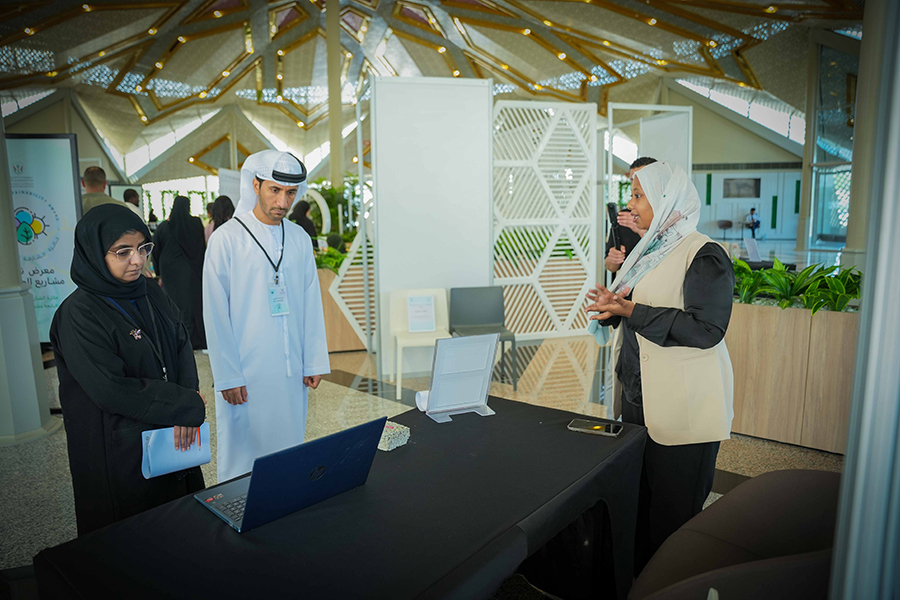
The Sharjah Environment and Protected Areas Authority in Sharjah (EPAA) organised the final evaluation exhibition for university student projects as part of the 14th edition of the Sharjah Sustainability Award for the 2025–2026 academic year. The event was held at University of Sharjah, bringing together a distinguished group of university students from across the UAE, alongside academic and technical experts, reflecting the award’s growing role as a catalyst for environmental innovation.
35 innovative projects showcased
The exhibition featured 35 innovative projects selected from 75 submissions evaluated during the preliminary phase (out of a total of 134 entries). Students presented advanced practical models and scientific displays that demonstrated a high level of innovative thinking across key sectors, including sustainable design and construction, energy and emissions reduction, scientific research for undergraduate and postgraduate students, artificial intelligence applications in sustainability, human and environmental health protection, and natural resource conservation.
A strategic platform to advance environmental innovation
Her Excellency Aisha Rashid Deemas, Chairperson of the Environment and Protected Areas Authority in Sharjah (EPAA), emphasised that the final evaluation exhibition represents a pivotal stage in the award’s journey, where innovative ideas meet specialised scientific assessment, enabling the transformation of student projects into practical, scalable solutions.
She noted that the advanced level of the showcased projects reflects the growing awareness among students of the importance of sustainability, as well as their ability to leverage knowledge and modern technologies to address environmental challenges.
Her Excellency Aisha Rashid Deemas added that the award serves as a strategic platform to foster a culture of environmental innovation and strengthen collaboration between academic institutions and various sectors, contributing to the development of national talents capable of leading the transition towards a more sustainable economy. She reaffirmed EPAA’s commitment to supporting such qualitative initiatives in alignment with the UAE’s vision for sustainable development and enhanced quality of life.
Practical and scalable solutions
The participating projects stood out for their focus on practical, applicable solutions that bridge scientific research with real-world implementation. This reflects a growing trend towards aligning higher education outcomes with sustainable development needs and reinforcing the role of research in addressing environmental challenges.
Specialised judging panels toured the exhibition, engaging directly with students to review methodologies, expected outcomes, and the potential for real-world application. This interactive process enriched scientific dialogue and enhanced participants’ presentation and critical thinking skills.
Specialised evaluation sessions
At the conclusion of the exhibition, judging committees conducted dedicated evaluation sessions based on rigorous criteria, including innovation, environmental impact, feasibility, and long-term sustainability. The winning projects for first and second place in each category will be announced during the award’s closing ceremony.
The exhibition forms part of an integrated evaluation framework implemented by the Sharjah Environment and Protected Areas Authority in Sharjah. This also includes the institutions category, where 18 projects from across the UAE were assessed, resulting in the selection of five institutions advancing to the final stage through on-site visits aimed at evaluating real-world implementation.
EPAA is also continuing the evaluation of school category projects, with outstanding entries set to qualify for the final stage, which will include upcoming field visits. This reflects its commitment to engaging all educational levels in the sustainability journey.